How attorneys get clients
How attorneys get clients in 2026: word of mouth, directories, advertising, bar programs and marketplaces where the client chooses. Plain costs, no hype, by situation.

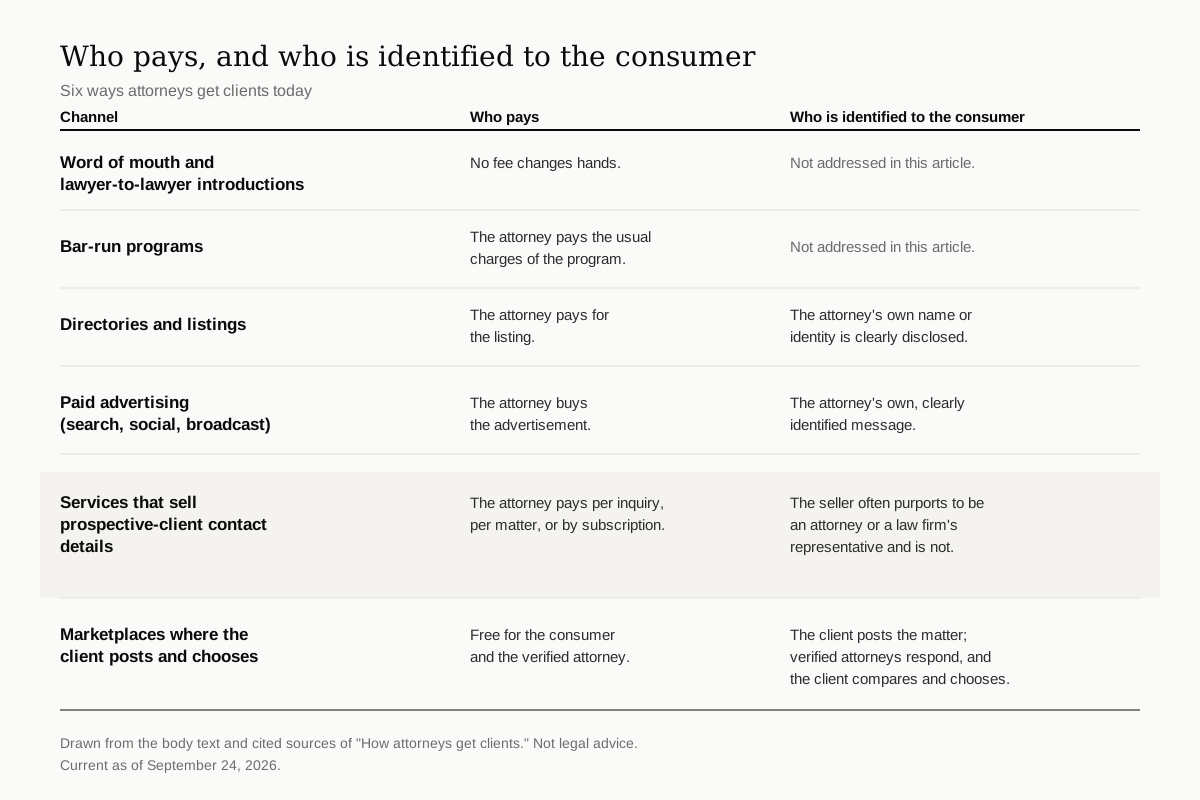
This page is a plain inventory of the ways a licensed attorney can get work in 2026 — word of mouth and lawyer-to-lawyer introductions, bar-run programs, directories, paid advertising, services that sell prospective-client contact details, and marketplaces where a client posts a matter and chooses whom to hire. For each one it says how the money moves and what the rules of professional conduct say about it, with the statute or rule cited in the sentence that states it. It is written for an attorney deciding where the next month and the next dollar should go. It is not legal advice, and it is not a substitute for your own state's rules.
What "getting clients" actually means
Two different problems hide inside the phrase. The first is being found: a person with a legal problem has to learn that you exist. The second is being chosen: once they know, they compare you against other lawyers and decide. Almost every channel below addresses only the first.
The second is where the conduct rules concentrate. North Carolina's Rule 7.2 treats a communication as a recommendation when it endorses or vouches for a lawyer's credentials, abilities, competence, character, or other professional qualities (N.C. Rule 7.2 cmt. 2, N.C. State Bar) — which is why so much of the law in this area is about who is allowed to say that you are the right lawyer, and who may be paid to say it.
On Legal Locate, the client reviews every offer and chooses their attorney themselves (Legal Locate, For attorneys). Nothing an attorney does on the platform makes a matter theirs.
Word of mouth and lawyer-to-lawyer introductions
No fee changes hands when a former client or another lawyer sends someone your way, which is exactly why the conduct rules pay attention to what does change hands.
North Carolina's Rule 7.2(b) prohibits compensating, giving, or promising anything of value to a person for recommending the lawyer's services, with four exceptions: the reasonable costs of advertisements, the usual charges of a compliant intermediary organization or prepaid plan, the purchase of a law practice, and nominal gifts of appreciation (N.C. Rule 7.2(b), N.C. State Bar). The "nominal gifts of appreciation" exception is in the rule's own text (N.C. Rule 7.2(b), N.C. State Bar); a standing arrangement to pay for sent work is a different thing, and whether it is permitted is a question for your own state's rule and your bar.
Rule numbering and substance differ by state. North Carolina's rule is cited on this page because its text is verified in this campaign's sources, not because it governs your practice.
Bar-run programs
Programs run by a bar association are one of the categories the conduct rules name expressly. North Carolina's Rule 7.2(b) permits paying the usual charges of a compliant intermediary organization or a prepaid legal service plan (N.C. Rule 7.2(b), N.C. State Bar) — a narrow permission, and one that turns on the organization being compliant, which is a question about the specific program.
If your state or local bar runs a program of this kind, the two things worth reading before you join are its published fee and the conditions the rule attaches to the exception (N.C. Rule 7.2(b), N.C. State Bar).
Directories and listings where you are clearly identified
A directory listing is advertising: you appear under your own name, and the consumer reads and chooses. That identification is doing legal work now, not just design work.
Colorado's statute defines "traditional legal marketing" as marketing by or on behalf of an attorney, firm, or licensed legal paraprofessional in which the advertiser is clearly identified to the consumer, and it names listing in legal directories in which the attorney's name or identity is clearly disclosed as an example (C.R.S. § 6-1-741(2)(b), SB26-174 enrolled act). The section states that it does not prohibit traditional legal marketing (C.R.S. § 6-1-741(5), SB26-174 enrolled act).
The practical reading: a listing in which you are the identified advertiser sits in a different legal category from a service that sells a stranger's contact details, even when both arrive as a monthly invoice.
Paid advertising: search, social, broadcast
Colorado's definition of traditional legal marketing doubles as a checklist of this category: search engine optimization, pay-per-click, radio, television, streaming, and billboard advertising, in each case with the advertiser clearly identified to the consumer (C.R.S. § 6-1-741(2)(b), SB26-174 enrolled act). North Carolina's rule treats the reasonable costs of advertisements as a permitted payment (N.C. Rule 7.2(b), N.C. State Bar).
What you are buying in this category is the advertisement — your own clearly identified message, carried where people will see it — and not a person's contact details. That distinction is the one the statutes turn on.
Services that sell prospective-client contact details
A different category of service charges an attorney per inquiry, per matter, or by subscription, and delivers a prospective client's contact information or a description of their legal issue. This is where the law moved in 2026.
Colorado's SB26-174 passed both chambers in May 2026, was signed on 2026-06-03, and carries an effective date of 2026-08-12 (Colorado SB26-174, General Assembly bill history). It added C.R.S. 6-1-741, which reaches any arrangement in which an attorney, law firm, or licensed legal paraprofessional pays money or other compensation to a third party to receive information about a potential client or case, including contact information or information about the legal issue (C.R.S. § 6-1-741(2)(a)(I), SB26-174 enrolled act). The definition covers compensation paid directly, indirectly, per inquiry, per case, or as a subscription, and paid through intermediaries or affiliates (C.R.S. § 6-1-741(2)(a)(II), SB26-174 enrolled act). It excludes fee sharing between licensed attorneys, firms, and licensed legal paraprofessionals done in compliance with state law and Colorado Supreme Court rules (C.R.S. § 6-1-741(2)(a)(III), SB26-174 enrolled act).
The permission side is narrow: a person may solicit a potential client or market for legal services in the state if they are authorized by the Colorado Supreme Court to practice law, are working on behalf of such a person who is clearly identified in the marketing, or are a nonprofit organization that engages in legal services in the state (C.R.S. § 6-1-741(4), SB26-174 enrolled act).
The General Assembly's own declaration explains the reasoning, and it runs in both directions: the practice is described as inherently misleading to consumers because the person conducting it purports to be an attorney or a law firm's representative and is not, and as misleading to the purchasing attorney because the information is often sold to multiple firms, is erroneous, or does not represent a viable case (C.R.S. § 6-1-741(1), SB26-174 enrolled act).
The consequences are not confined to professional discipline. A violation of the section is a deceptive trade practice under the Colorado Consumer Protection Act (C.R.S. § 6-1-105(1)(tttt), SB26-174 § 1), and the section gives an affected attorney, firm, or consumer a civil action with damages of ten thousand dollars per violation plus reasonable attorney fees and costs (C.R.S. § 6-1-741(6), SB26-174 enrolled act).
What other states do, and what is pending rather than enacted, is set out on the rules on paying for clients, state by state.
Marketplaces where the client posts and chooses

The newer category inverts the direction. Instead of an attorney buying a person's contact details, the person posts their matter and the attorneys who are interested respond.
Legal Locate works this way. A client posts a case; the key facts reach your phone the moment it is posted — the jurisdiction, what happened, what is at stake — and you decide whether to pursue it, with no bidding (Legal Locate, For attorneys). Verified attorneys licensed in the case's state apply with their estimated offers from the moment a case is posted (Legal Locate, How Legal Locate works). Every fee figure is a non-binding estimate, and the final fee is set with the attorney in a written agreement (Legal Locate, How Legal Locate works). The client compares offers and chooses, and the case stays open to new applications and offers until the client confirms they have located their attorney (Legal Locate, How Legal Locate works).
Your feed is filtered to your licensed jurisdictions, with practice-area filters you control (Legal Locate, For attorneys). Your bar license is verified against official state bar records before you can respond to a posted case (Legal Locate, Frequently asked questions). Legal Locate does not recommend, rank, or select attorneys, and receives no portion of any legal fee (Legal Locate, Our Compliance Commitment). The marketplace is free for both consumers seeking legal help and verified attorneys providing legal services (Legal Locate, Frequently asked questions).
The questions attorneys ask about this are answered on how Legal Locate works for attorneys, and every channel on this page is set side by side in ways for attorneys to get clients, compared.
By situation
- how to get clients as a solo attorney — when the constraint is your own hours.
- your first clients as a new attorney — when there is no book of business yet.
- client acquisition for small law firms — when the channel has to work past one attorney.
By practice area
The worked example for a single practice area is how to get family law clients.
Before you pay anyone for clients
Two bodies of law now apply to this question, not one. Your state's rules of professional conduct govern what may be given for a recommendation (N.C. Rule 7.2(b), N.C. State Bar), and in Colorado a consumer-protection statute now applies on its own terms, with the violation sitting in the Consumer Protection Act rather than in the conduct rules (C.R.S. § 6-1-105(1)(tttt), SB26-174 § 1). Start with the rules on paying for clients, state by state.
Every statement about a rule or statute on this page carries its primary source in the same sentence and is accurate as of 2026-09-24. Nothing here is legal advice or an opinion about your own compliance. Check your state's rules of professional conduct and consult your bar.
Frequently asked questions
Which client-acquisition channels cost an attorney money?
Advertising costs money by definition, and the reasonable costs of advertisements are a permitted payment under North Carolina's rule (N.C. Rule 7.2(b), N.C. State Bar), as are the usual charges of a compliant intermediary organization or prepaid plan (N.C. Rule 7.2(b), N.C. State Bar). The Legal Locate marketplace is free for verified attorneys (Legal Locate, For attorneys).
Can an attorney pay someone for sending them clients?
Only within the exceptions the rule allows. North Carolina's Rule 7.2(b) prohibits giving anything of value for recommending a lawyer's services except reasonable advertising costs, the usual charges of a compliant intermediary organization or prepaid plan, the purchase of a practice, and nominal gifts (N.C. Rule 7.2(b), N.C. State Bar). In Colorado a statute now applies in addition to the conduct rules (C.R.S. § 6-1-741(3), SB26-174 enrolled act).
What does Legal Locate cost an attorney?
Nothing to participate. The marketplace is free for both consumers seeking legal help and verified attorneys providing legal services, and attorneys never pay for access to consumers, legal matters, or marketplace participation (Legal Locate, Frequently asked questions). Legal Locate receives no portion of any legal fee (Legal Locate, Frequently asked questions).
Which states is Legal Locate available in?
Legal Locate opens state by state; tell us where you practice and we will email you the moment your state opens to founding attorneys (Legal Locate, For attorneys).